plum nine
stockholm, se, re: the show, technology, contingency
Greetings from Sweden! I’m off to Paris tomorrow for the last date of the tour. I’ll be back in dear Chicago by the end of the week. Am I tired? YOU BETCHA. Am I full of gratitude and surrender? YOU BETCHA. Mystery and joy and terror abound.
I want to tell you more about the piece, Essay on Resonance. I need to talk about tech bc there’s a lot of it! This might be a little bit of inside baseball, but hopefully it’s moderately interesting. If you want words about ideas, check out the previous plum. I’m here to talk shop.
Here’s what’s on the stage…
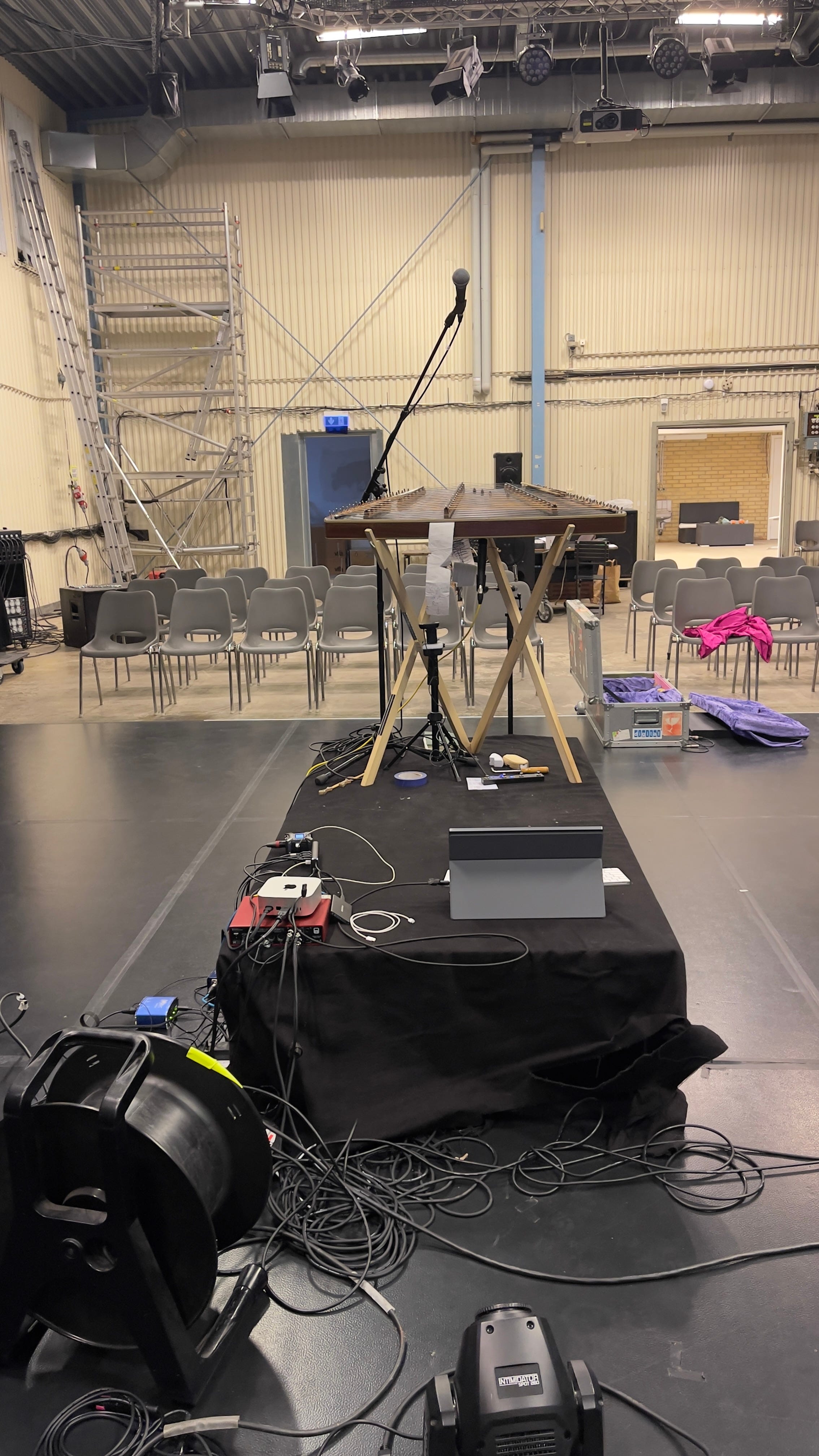
Center stage:
Hammered Dulcimer.
Under Hammered Dulcimer:
An LED light with a webcam taped on it, facing toward the underside of the dulcimer.
Also under the Hammered Dulcimer:
A MIDI controller you operate with your foot.
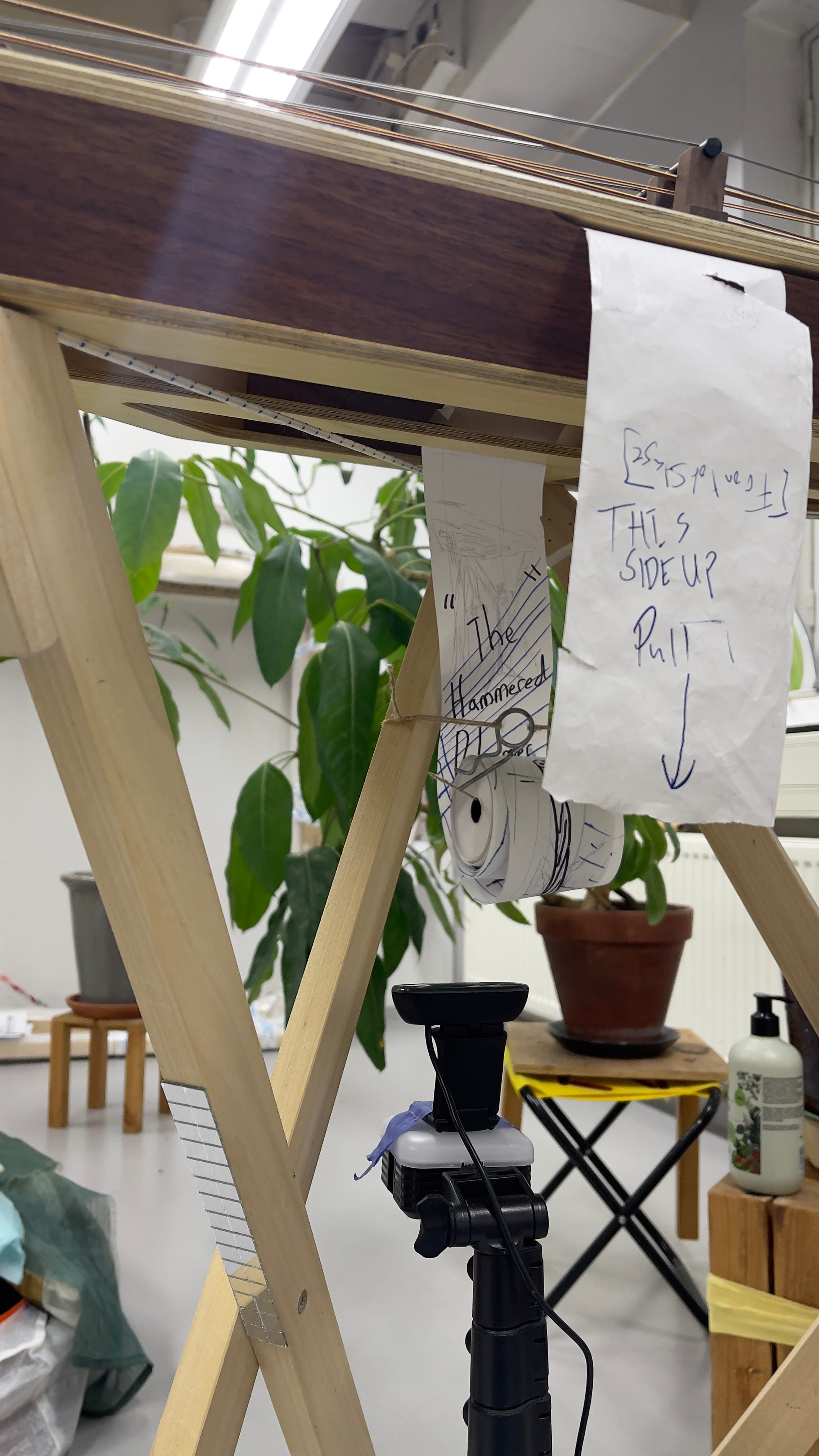
Strung up on a string on the dulcimer stand:
A roll of receipt paper with a bunch of illustrations on it. This is threaded through the inside of the dulcimer. The webcam points up to see this.
Little upstage from center:
Moving spotlight, programmed to be synced with the music.
On the floor, centerish:
My Mac Mini1, plugged into all sorts of wires and nonsense
A little to the side of that:
A “Tweeter” speaker pointed at an ultrasonic microphone plugged into a Zoom F3.
Somewhere in the space, pointed at the upstage wall:
A projector, also plugged into that Mac.
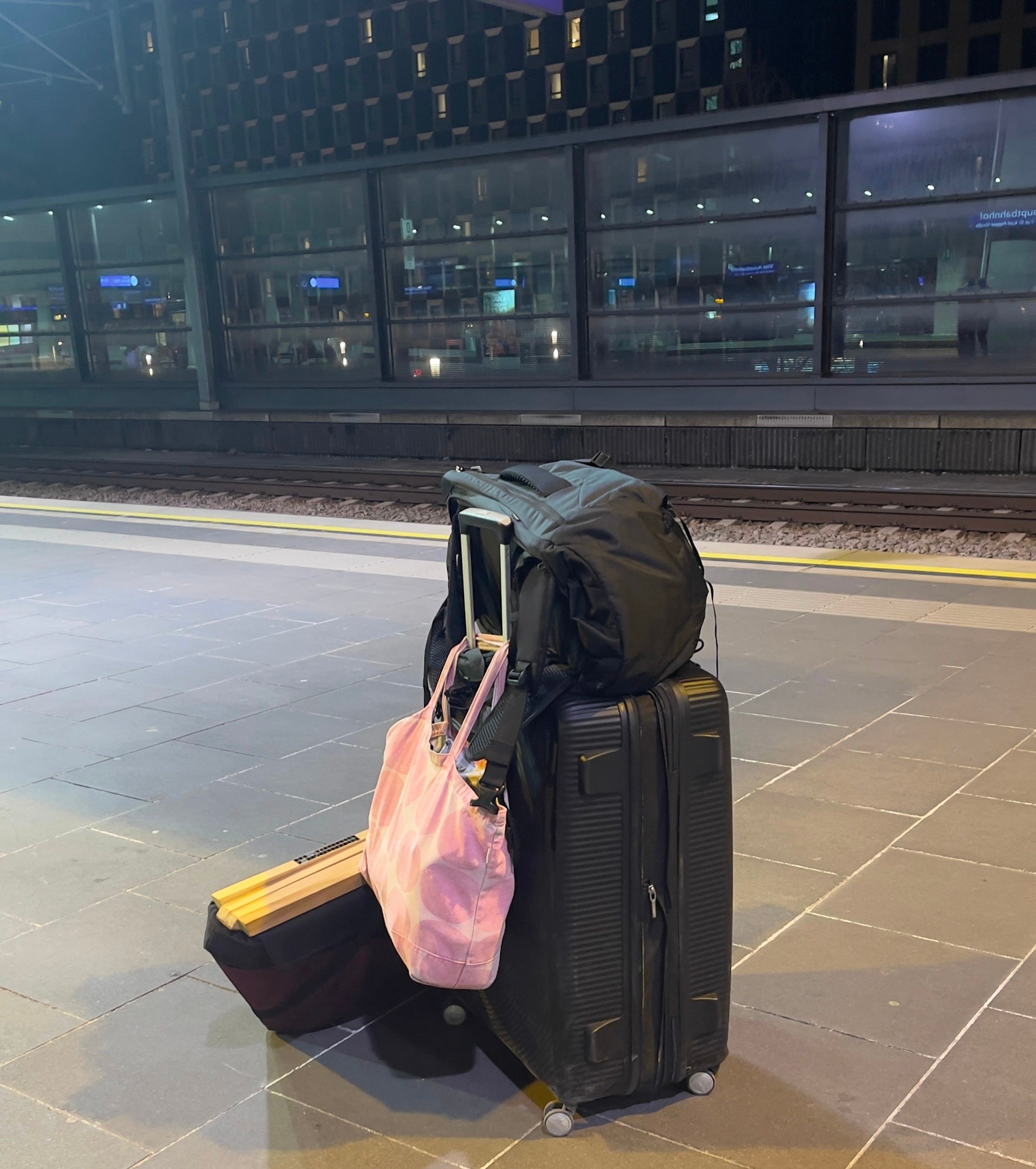
It’s both a remarkably streamlined/portable/tourable set-up and also the edge of what is humanly possible to carry. I had to buy a new, bigger, suitcase in Helsinki because I realized it just wasn’t going to be doable without the BIGGEST suitcase. It’s embarrassing to wheel this thing into the airport. I feel like a tourist who needed their whole wardrobe, but they don’t charge extra for the size of the checked bag, just the weight, you know? The equipment’s not heavy, just bulky!2
“The show” is a solo production, that’s part of the point. It’s thrown together, controlled, performed, lit, scored, written, danced by me. There is something very egotistical, solipsistic in this that we should be suspicious of. There is also something that is sexy and generous about a good solo show (which I hope that it is!). I like the thrill of the magic show, where we watch a single magician work their ass off to seem effortless.
Not to mention: I don’t have the budget to hire anybody but me. It’s a very cheap piece, all things considered. This is what I’m trying to embrace — with this bit of tech that fits in a (big) suitcase, a performance falls out….
For this show to work, there are three major “zones” that need to be coordinated. Those are:
The Backing Tracks
The instrumental tracks in the box, unchanging in the live environmentLive Microphones
My voice and the dulcimer and the audio effects that shift on/off of themThe Visuals
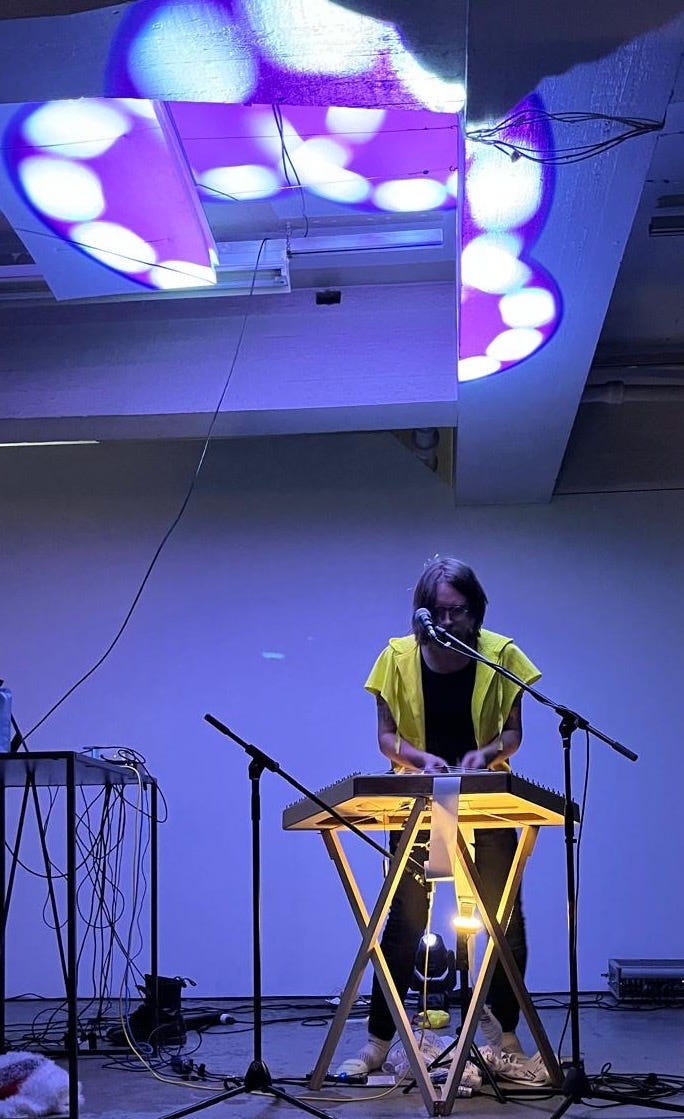
The lights and projections synced up with the sounds. This is largely pre-programmed material, but there is one passage with a live webcam, a-la a crankie3, and one passage involving the live projection of my computer screen, a-la a lecture explaining how to work some software.
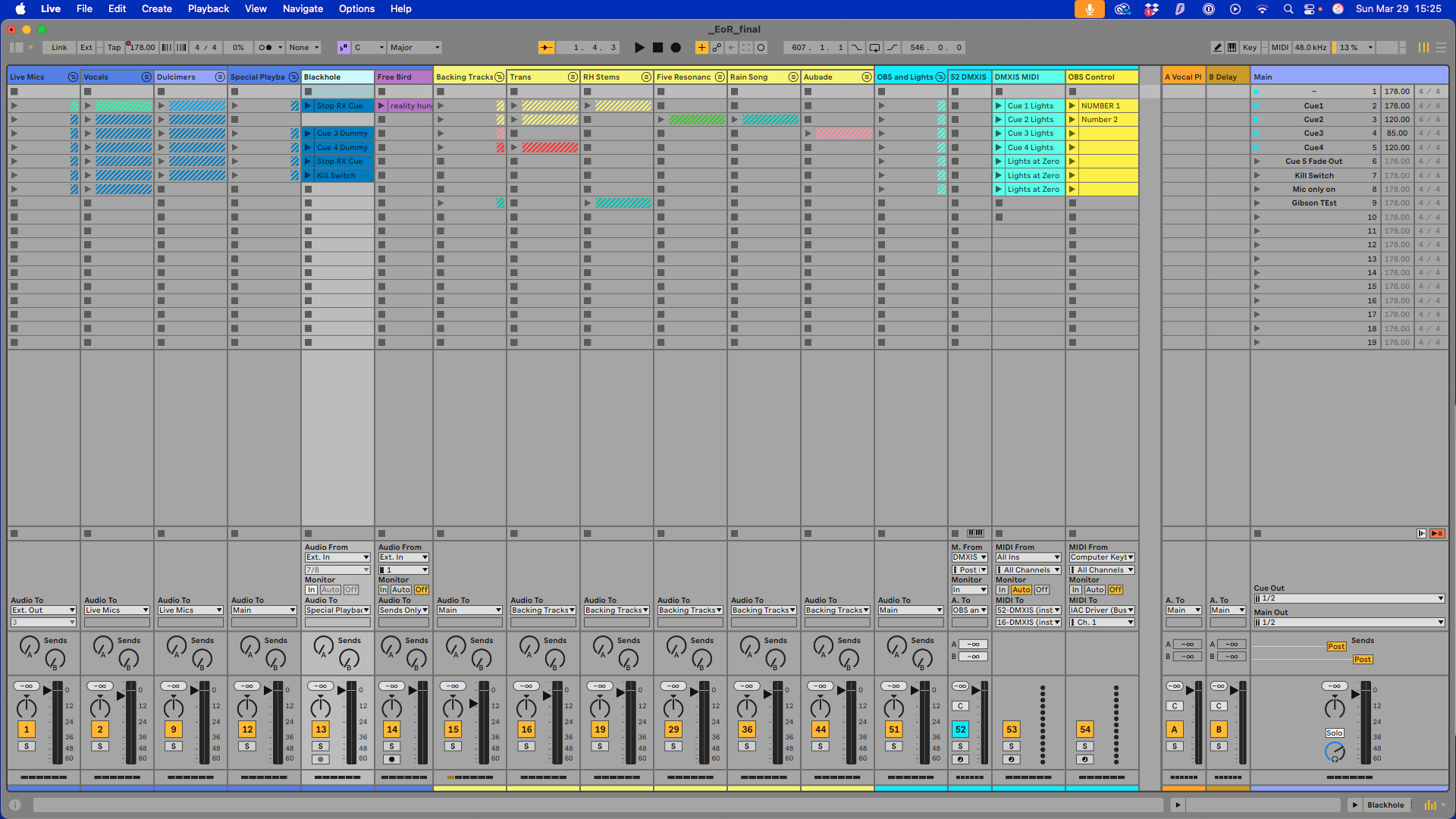
This is all organized using one piece of software, which also happens to be the software I use to write music: Ableton Live. Your ex-boyfriend’s favorite part of computer, this program is a little bit designed for DJs, which makes it a really fun and flexible tool for live performance.
A few words on these component parts…
BACKING TRACKS
This is, more or less, the simplest part of the show technically. Funny, because artistically the most involved! I wrote some music, which took a long time. Then I exported a version with the vocals removed — more-or-less a karaoke track. You hit play on an mp3 and you sing along. Simple! That’s the show!
There are a few more moving parts in this zone of the piece, which concern some special, singular moments. There is the isolated guitar solo to “Free Bird,” which isn’t played out through the main speakers, but instead filtered through my voice during the guitar-solo section in the opening number. I was told this was the “overwhelming” part of the show by some Finnish colleagues. They encouraged me to keep it in.
There is also a special mp3 file that doesn’t go through the main speakers and instead gets routed through my tweeter on the floor. All of the sound that comes out of the speaker is super high frequency, dog-whistley stuff — all above 20hz, so you can’t hear it. You might be able to feel it, but only as a slight buzzing sensation. These high frequencies get played at a very specific moment alongside a dulcimer improvisation. Later in the show, I take a *recording of that improvisation* and slow it down, to reveal all of these sounds that were present in the room but not in our human perceptual field. Does that make sense? Like a magician would, trying to make you rethink your own senses.
LIVE MICROPHONES
Again, not super difficult here, it’s just about coordinating when things turn on and off. Mostly: turn the vocal mic “on” when I need to use the mic and turn it “off” when I won’t be singing or speaking. Also: turn the vocal effects “on” at the right moment and “off” when they aren’t needed.
VISUALS
There are two tracks that control visuals — one controlling a moving spotlight, and the other controlling projections. That sounds complicated, but I promise it’s really not, once you release yourself to it. The projector is all controlled by OBS, which is a free piece of software that streamers use for sexy camera changes.4 The spotlight is all controlled via DMXIS, which is...uhh…not the simplest part of the show. The software has been discontinued, and it’s generally a bit more clunky than I’d like. But it works for me!!! You build a light look & then it’s associated with a MIDI note and then you can program the transition time from look1 to look2.
The thing I like about these tools is that you can be VERY temporally specific with timing. Ableton has a display that is a little bit like a musical score, so it feels very familiar to conservatory trained me. The visuals then become just an extension of the music. Sexy.
I complain often that I have accidentally become a technologist. Experimental music and sound art have become conflated with a certain technical orientation. This is perhaps an unfortunate thing.5
Case in point: when I arrived in Chicago, and I told people I was “a composer” they assumed this meant I could run a sound board. I suppose that makes sense, but it just wasn’t true.6 However. I, in need of money and friends and work in the arts, would just say “yes i know how to do that” and figure it out on the fly. I recommend this course of action to anybody, if you need a job. You can google the manual for any sound board you find, and if you look at it on your phone, it looks like you are texting and not panicking about how to turn the thing on.
Regardless, I’ve found myself behind many a soundboard and many a piece of technology. I’m not very good at being an engineer, but I am good at taking a piece of technology and toying with it until it does something that I like. I’m trying to build a career on this.
I just had a really wonderful fika with Ryan Packard, Chicago expat in Stockholm, who said something that blew my mind — that a computer, despite all its pretending to be stable and fixed, is just as frail and changing and fallible a creature as any of us. It would be one thing if you just hit “play” and then the performance happened, but it’s not so simple (is anything ever so?). Instead, the performance-with-technology is a negotiation between interconnected parts, the chance that the tech hiccups or the placement of the speakers is different than before or the vibes are just inexplicably different in the room, or the chemistry of your body is different or the chemistry of your audience, or or or or….How many things can change around you! All of those things are important! It’s subtle, but just because subtle doesn’t mean not powerful.
Anyway, maybe it’s not a solo performance after all, instead: a collab between me and a bunch of wires and electricity and people next to me. I think that this stuff is part of the *meaning* of the work. The technology is a duet partner, and her part is just as interesting and artistic as mine.7
This is a wonderful thing about performance when you really, truly consider it as a medium — it’s never one thing, always “also,” always “already,” always “contingent,” always “new.” If I really had to travel with all of the piece, I would be bringing every audience and room with me. And I’m flying Ryanair tomorrow. Wish me luck.
love you8
c
Lol here’s a fun part about this trip: I don’t have a laptop, I just have a “deconstructed computer.” I’m walking around with a portable monitor and a tiny little desktop computer and some cables to make it all talk. It’s a pain in the ass, both because everything takes some time to setup/breakdown, but mostly because I need access to an OUTLET in order to have my computer time.
However, would totally recommend for the technologist in your life because these new mac minis are very affordable (all things considered) and have HORSEPOWER. You can run all sorts of crazy real-time effects on your voice, and the computer is fast and reliable. I’m doing a LOT with this computer, and it hasn’t once fritzed during a live performance.
I take it back, it’s actually really heavy. I just pulled out my portable luggage scale, and I think it’s something around 110 pounds combined of clothing and equipment and STUFF.
Does this make any sense? It makes sense when you see it. Here’s a tiny vid from an audience member of the crankie set-up:
At the very, very beginning you can see the live webcam projection behind me.
Again, for the heads: OBS control — I use the IAC MIDI Driver (included on all macs) routed to this OBS plug in which takes MIDI information and translates it into scene changes.
See the fact that the School of the Art Institute recently merged its “sound department” and “art and technology department” into one. The artistic politics of this are quite interesting! I’d write more on this if I thought it wouldn’t get me in trouble.
The funny thing is that my training was about memorizing the range of every instrument in the orchestra, analyzing 12-tone music, writing papers explicating metaphors within Schubert songs. This stuff is fun, I stand behind it as an intellectual pursuit! But also, as soon as I got a job outside of the university, I had to plug in a microphone, something I barely knew how to do. Perhaps I could have learned this in music school.
Although significantly less embodied, lol.
Just in footnote tradition, something special as digestif. I went to a coffee place the other day with a LOT of mirrors in the bathroom, and just look at the dumptruck it gives me!