

plum five
denver, colorado, re:the profane, the divine, the squawk
It’s hard to explain the relationship that Clay Gonzalez has to my life. He is a very, very close friend — somebody who has seen me in all states, from confusion to elation to despair. He has been my roommate twice, my artistic collaborator for 14 years and counting, and is directly responsible for my sense of having a home in this world. I hope to keep him in my life until I die, and I hope in whatever afterlife there is, our energies get to mingle together until the heat death of everything.1
I will also be so bold as to say: he is likely the best artist I know.
Clay’s principal work for the past several years has been a project called the Regenerate! Orchestra. The orchestra is many things all at once— a social practice, a community band, a vehicle for Clay’s huge ambient aleatoric compositions. Let me try to impress on you how important the Regenerate! Orchestra is.
The music is somewhere between an Oliveros Sonic Meditation, an AACM improvised session, a site-specific Cagean opera, and a ritual to honor Mother Gaia off two tabs of acid. It’s also a community gathering and free meal with every rehearsal and a project to repair “classical music” into something sustainable and oriented toward community. Members of the orchestra regularly say that the experience is fundamental in healing their relationship with making music, with their instrument, and with the act of performing. (Which, if you have any familiarity with a “classical” art form, is a huge deal! We have somehow taken these beautiful and joyous things — ballet, orchestral music, etc — and turned them into stressful pageants that breed eating disorders, drug use, crumbling mental health, the whole deal.)
The rules are: anybody can join the orchestra, regardless of instrument or skill level. Some members are professional musicians who can play Flight of the Bumblebee faster than you can think, some are genuine children who learned Frère Jacques two hours ago.
All of the repertoire the orchestra plays is modular and open — the music, because it operates in loose “ambient” structures, is flexible enough to include anybody and everybody. Clay writes a unique part for each participant. I think that this nearly kills him every time, but he’s getting better at the workflow.
Now. The words “community orchestra” suggest a certain artistic flimsiness. I don’t want to have that thought in my head, but I do. The Regenerate! Orchestra is not flimsy. Clay has lofty, big ambitions with this music. He wants this music to be Important and Meaningful in a canonical way, in conversation with greats in the field (John Luther Adams or Lisa Bielawa are two capital C composers that are the clearest analogs, there are certainly many more). This is part of what makes this ensemble so special — Clay refuses to settle. It is about music, yes, but also community. It is about aesthetic greatness, but also about healing a trauma. Regenerate! wants it all.
Anyway, all of that is to say, I cannot begin to tell you how excited I was when Clay asked me to write something for the group. Regrettably, I’m going to do something borderline inhumane with this group of amazing people.
I’ve had this idea in my pocket for a piece about rubber chickens. We might trace it back to one of my favorite internet videos, that vine of somebody pressing down on a bunch all at once. We might also trace it back to when I was in Chinatown and bought a rubber chicken on a whim, because it was one of the objects in the store that made a sound. I don’t know where exactly the itch came from, but I’ve been desperate to scratch it.
Why though? Glad you asked.
Because I find rubber chickens to be quite challenging. I have a lot of feelings about them. Not good feelings. The sounds they make are grating and inelegant and not especially nuanced. They are uncool. They are nauseatingly plastic and if I seriously looked into the environmental cost of, I don’t know, buying 100 of these guys from a warehouse in Ohio, I just might swear off air travel for the rest of the decade. As a building block for a piece of music, they have a comically limited palette and lend themselves to a kind of irritating drone that, one imagines, is borderline torture. Chickens are great, love those guys. The rubber iteration is a crime. There’s gotta be a piece in that!
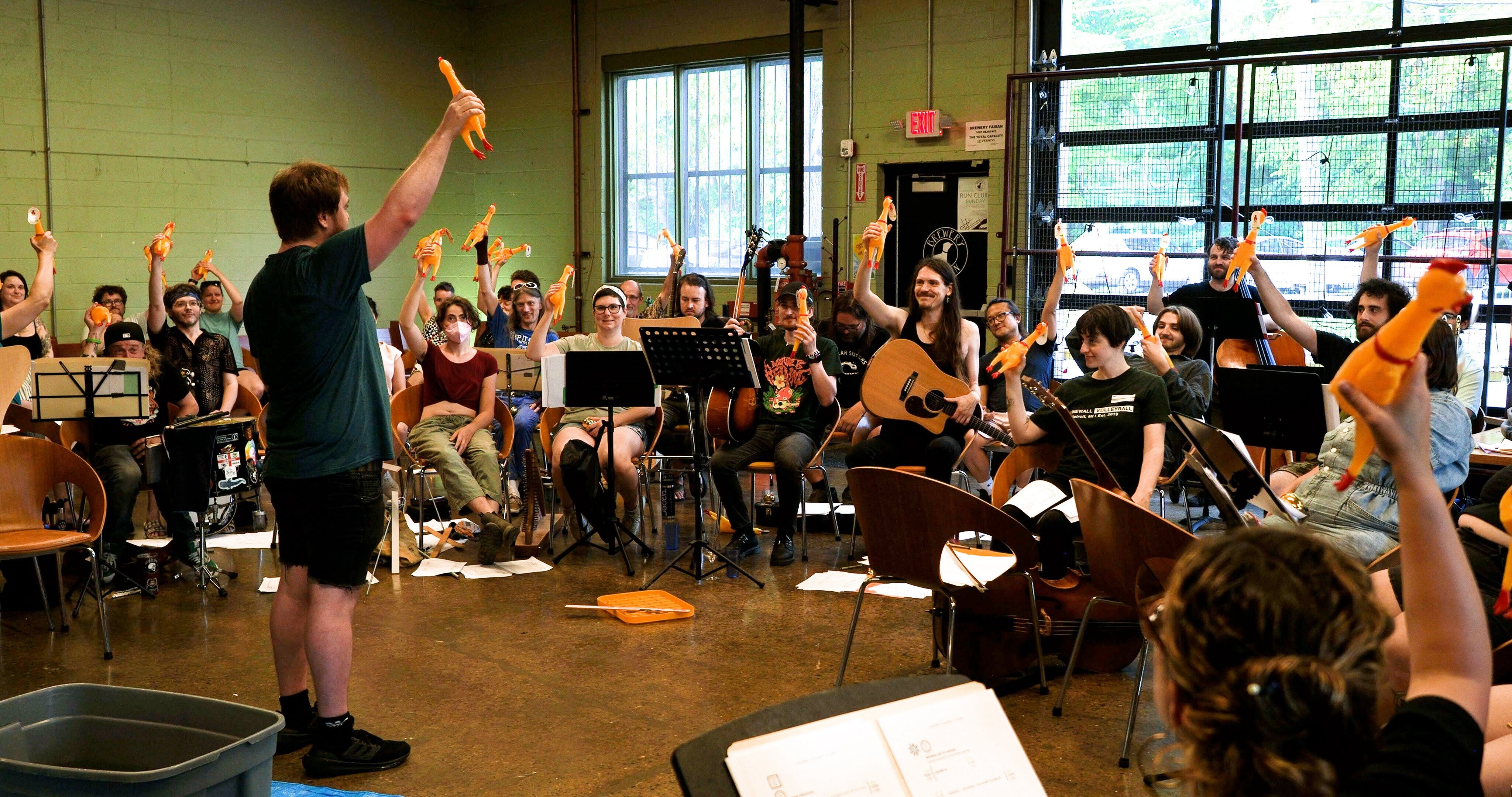
I had a draft called “CHICKEN OR THE EGG” to Clay in the middle of May. It involved everyone in the orchestra getting an egg shaker (plastic easter egg filled with black beans — professional eggs are expensive) and a rubber chicken (these are marketed as, technically speaking, dog toys). The sketch of the score looked something like this:
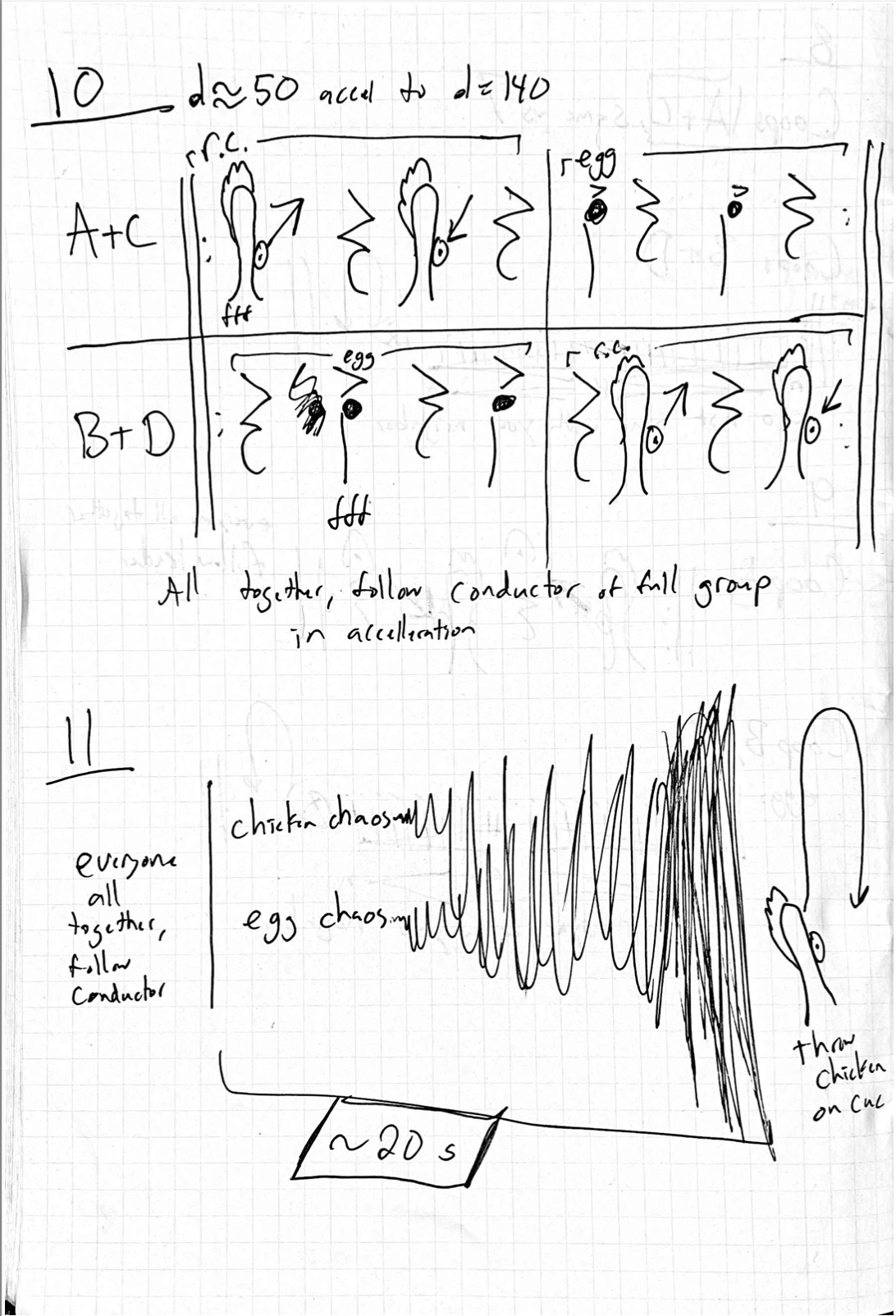
We don’t need to get into the weeds with it, but this wasn’t a simple proposal. I had the 60-person ensemble divided into four “coops,” each with an appointed leader, and instructed the performers to move between independent sound making & coordinated coop-wide action. There were accelerando marks and decelerando marks and nientes and fortississimos and I felt like Stockhausen.
Clay came to me with notes: it’s not gonna work. Too complicated, too specific. The orchestra is a well-oiled machine when a stopwatch runs the show2. But having a conductor? Let alone four conductors who are constantly trading off who is in charge? And then group dynamics? AND rhythms? That’s something the ensemble has never ever practiced. Here’s a choice quote:
“The skill of playing together rhythmically is not one we have.”
This was a surprise to me. In my mind, a swell of dynamic or a conductor giving a downbeat seems like the simplest orchestral gesture. I forgot I wasn’t writing for orchestra, I was writing for Regenerate!
A different thing entirely.
Robert Ashley has a set of liner notes where he writes about the designation of “Experimental Music” being a frustrating one. He is insistent that there isn’t any experiment implied in music, that the act of making music is “an act of absolute confidence.” This POV has an interesting rhyme with Cage, who, for a while in his youth, disavowed the phrase “Experimental” for similar reasons — he knows more or less what is going to happen with any piece, even within his iconic use of chance operations. (Cage later came around to the word & used it extensively.)
I think these are pretty interesting thoughts, and being specific about our terminology never hurts3. I, for one, need to think more about the scientific method — hypothesis, experiment, conclusion — and how this maps onto my creative process in ways that are alternatively useful or misguided.
Ashley’s stringent definition of “experimental” forces some interesting conversations about what art gets put in the experiment pile. If chance-based music is not an experiment, then there are a host of other procedural or algorithmic compositional techniques that suddenly find themselves on shaky experimental territory.
(And then! Is improvisation experimental? To the extent that the performers don’t know what is going to happen, yes. To the extent that we are evaluating for something…less so? )
Ambient music, I think, makes the experimental cut, in the “Brian Eno listening to harp music very quietly in the hospital” sense4. (The aural presence of the environment is always, at least a little, an evaluatory dance with the unknown.) As the frame around the environment itself, field recording is likely “experimental.”5 Blah blah blah all I mean to say is:
The rubber chickens are an experiment.
Hypothesis: there is the divine in the profane.
Differently stated: it takes about 15 minutes of squawking to see God.
I have been thinking about that first draft of CHICKEN OR THE EGG and how thoroughly Clay told me to change it.
Part of why the first draft of the score didn’t work (on top of the “coordinated rhythms” problem) was that the notation gave each participant full context of what the others were doing. I thought that that information would simplify the process and empower the orchestra members. (Instead of traditional sheet music, where you only get your own part, here is a global view where you can locate yourself as a member.) Clay instead offered that this would add a whole bunch of friction, simply because of the way the music was conceptualized on the page.
Some hard-won-Clay-wisdom: with Regenerate! you’ve got to write music that is legible almost immediately. Maybe there’s time for one or two questions with the group, but largely the rehearsal process is: hand out the sheet music and now five six seven eight, let’s go. We learn by doing, not by planning out what everyone does at every moment. (Echoes here of “folk” musical traditions, learning by ear, except in this situation, the “tune” has a bit more of a rubbery feel.)
A big question at the heart of Clay’s feedback: What is the amount of information necessary to understand one’s part in a musical whole?6 He proposed Composer as Sieve — giving everyone exactly enough information to do their parts well (with enough room for personal contribution). No less, no more.
Clay and I spitballed that the version of the piece that gave the most freedom to the ensemble might be the simplest and best option. The compositional act was not organizing the sounds or instructing people what to do, but instead acquiring the chickens in the first place.
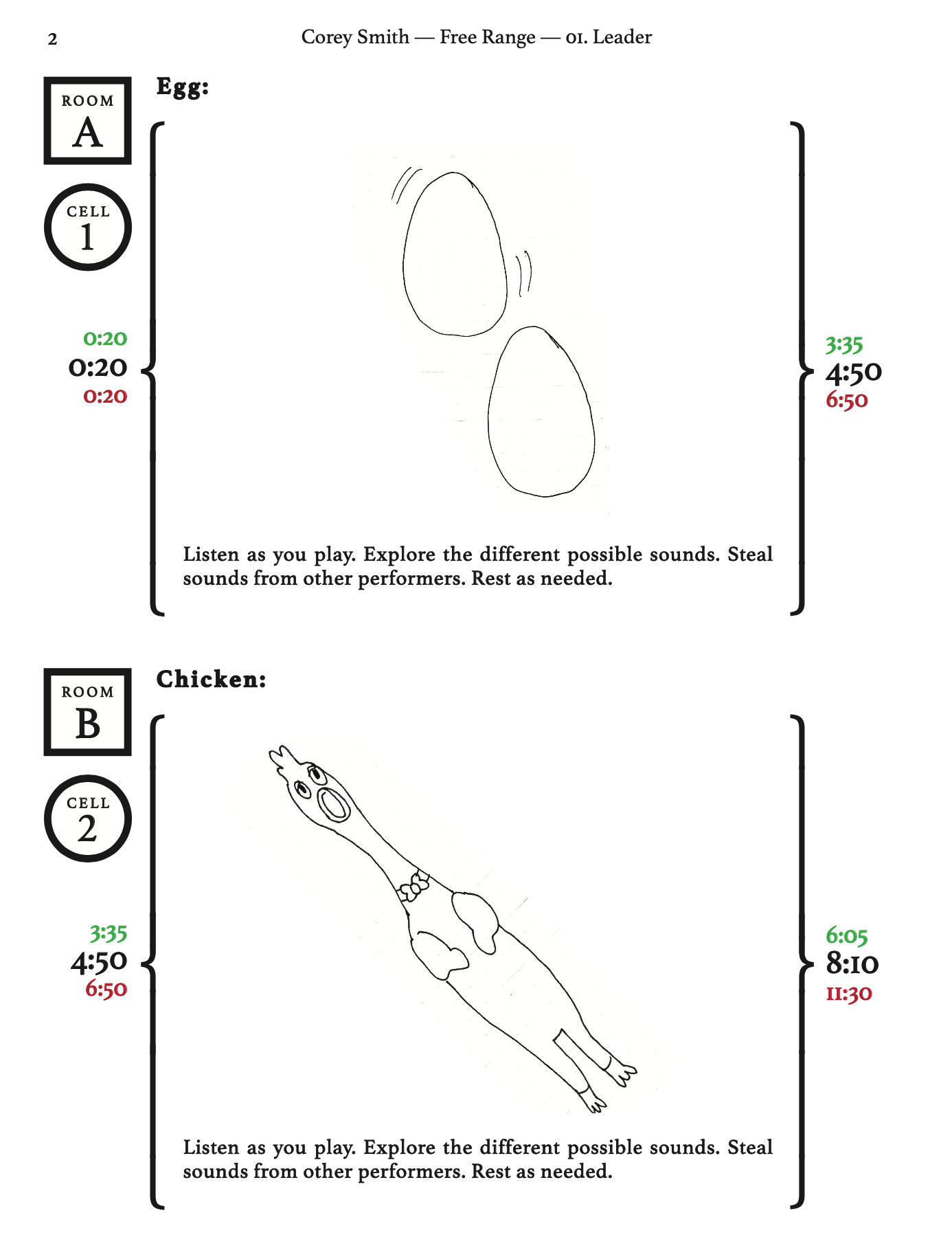
These conceptual changes merited a title change. The final piece is now called FREE RANGE, and the score has been drastically simplified. It is composed of (basically) just two instructions. First instruction is a drawing of an egg. Second, a drawing of a rubber chicken. (The illustrations are done by the incomparable Ellie Mejía.)
From above, it looks like this, mapped out in the Regenerate! house style — an excel spreadsheet.
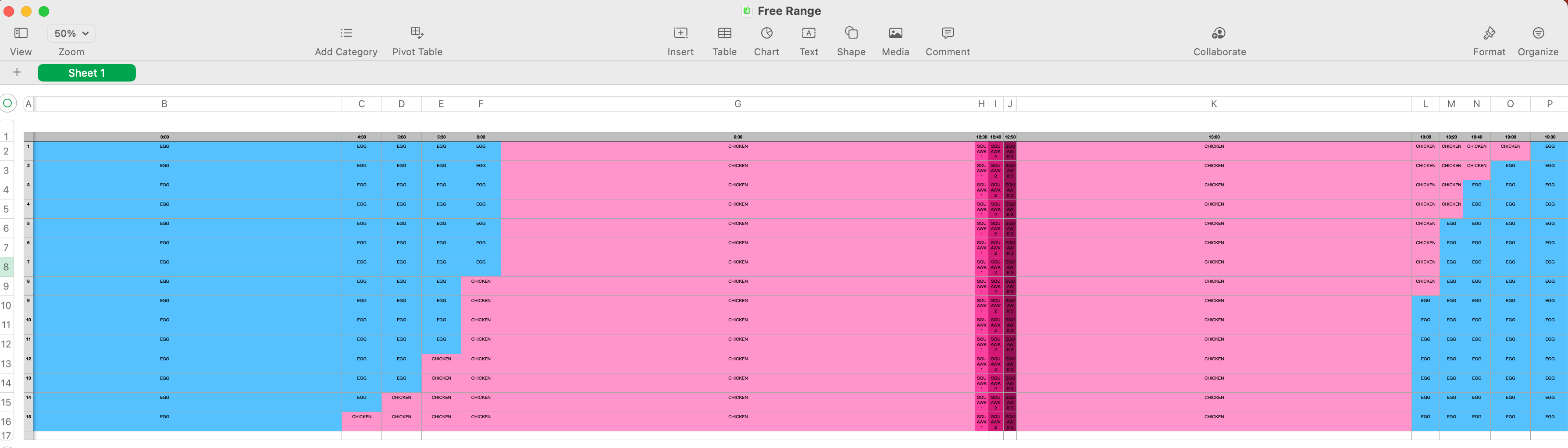
There are fifteen parts, distributed at random to the ensemble. The blue is egg. The pink is chicken. The sonic experience is pretty much: everybody egg shakers, exponentially switch to rubber chickens until it’s just chicken city. Three unison SQUAWKS with a big silence in the middle and then put your thing down, flip it, and reverse it, chicken into egg. (I have found that the silence-in-the-middle is a huge relief inside the, ahem, aural assault.)
As a matter of fairness, Clay insisted that I run the piece in my room before subjecting it on anybody else. I relented and made a little mock-up and dudes. I’m so delighted to say, the piece is FUN. It’s definitely grating and emotional. Not necessarily easy to listen to, but very much interesting. It feels like a fever dream. Just because you asked nicely, here’s a little snip:
If you or a friend is in Southeast Michigan, the premiere is TOMORROW, June 30th in Detroit, tickets and info here. Otherwise, I’ll be sure to get a recording & play it as loud as possible from any speaker with a dangling aux.
love you,
c
Clay has a kind of magnetism to him that is irresistible. You know that trope of the narrator in a novel being a kind of boring person who is enthralled by someone else who is actually the heart of the thing? I’m thinking about The Great Gatsby, but there are a million other examples, none of which are coming to my mind. It took me a long time not to feel like Nick Carraway when Clay was around. He’s that interesting, and I’m that obsessed with him.
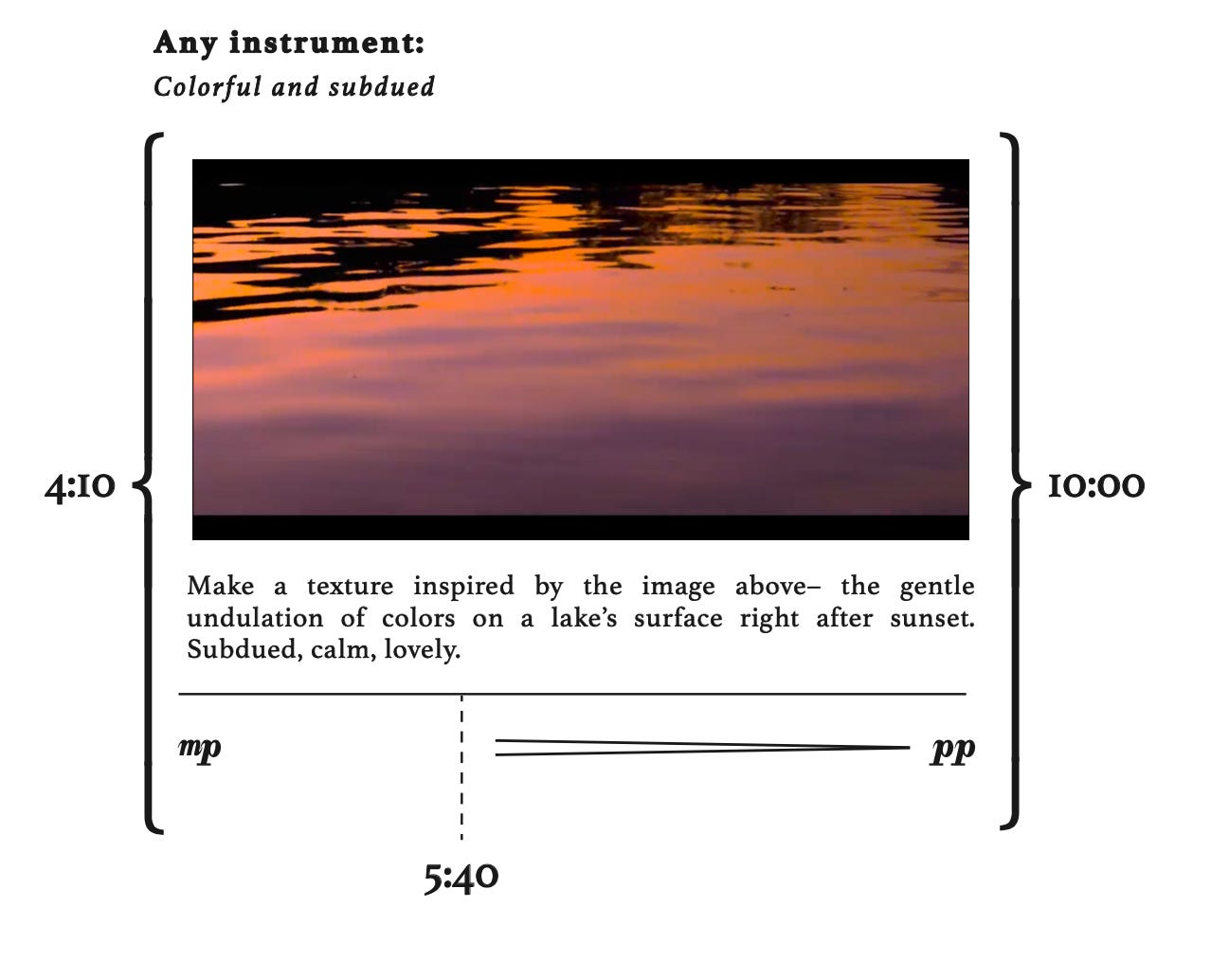
Much of the Regenerate music is written to times on a stopwatch. Everyone syncs their watches at the beginning and then just follows the instructions as they relate to time-code. There will be a bracket of time, say 1:00 - 3:00, and it will give you a task to accomplish in that time. Sometimes it’s poetic and evocative: “make a sound that reminds you of coming into a warm room after spending a long time in the snow.” Sometimes the instructions are more musically specific: “Repeat a loud sound as fast as you can, taking breaks when needed.”
Ugh, I know “Experimental” now is more a genre signifier than anything else. I mean to the extent that genre is useful, I find “experimental” useful. If you bill a show as “harmonica songs” I’ll try to make it. But if you bill it as “experimental harmonica songs”…I’ll see you at the show.
Which I recognize is not everyone’s definition of ambient. I’ve had some wonderful conversations with Nick Merryhew about this topic — they are very ambivalent towards the prettiness of so much ambient music, which definitely feels worthy of interrogation. In this violent, incomprehensible world, they seem insulted by coddling reverby synth chords. They want to be challenged, not pandered to by the artistic encounter! Can there be poetry after Auschwitz?
And yet, even with such big words, both Nick and I agree that music is probably a net good for the world, and it’s not worth getting too worked up about major chords when we’ve got bigger fish to fry.
Which brings me to an important aside. I did some file housekeeping the other day and found an unlabeled recording that CONFOUNDS me. It’s an hour long and documents a trip on the CTA, but I don’t know where I was going, where I began, what on earth was going on. It’s an hour long, so I won’t bore you with the whole of it, but here’s a supercut just to give you a taste. These sounds went into one of my ears and out the other, apparently.
I highly recommend headphones, if you’ve got ‘em. I recorded this with a pair of microphones that are sort of binaural. It sounds like your head is where my head was!
And, for that matter, what amount of information is necessary to understand one’s part in a societal whole? Impulsively, I would say that we should probably know more about the workings of everything — government, medicine, textile production, etc, etc. But writing this piece has made me rethink some stuff. Everything is so complex, it may be important and necessary to not have to hold every bit of information all at once? This seems like a delicate and important question, accidentally instigated by those horrible rubber chickens.
corey this rocks A LOT