

plum ten
pilsen, chicago, re: ego death at porte maillot, bandcamp release and chicago show date(!)
Ahh, well, nevertheless!
Here’s what happened: Paris Beauvais is a fake airport. It’s like a warehouse in a field. The idea is you pay RyanAir less money for the plane ticket and then get trapped in rural France, where you pay different money to the bus company to take you into the city.
I will say, the ride from Beauvais to Paris is 𝓼𝓽𝓾𝓷𝓷𝓲𝓷𝓰. It’s genuinely honestly earnestly the French countryside. Rolling Van Gogh fields, hyperchromatic blur. Maybe I was tired from the flight, maybe the flock of Polish girls behind me had put on too much perfume, but I felt like I was hallucinating the landscape tumbling by in mesmerizing green and yellow and green and yellow and then all of a sudden it was big white boxes. The suburbs rolled in in their strange, uncool European way.1
I took a photo of the Parisian suburban skyscrapers and texted it to E and wrote: “I see Jacques Tati!.” The bus pulled into a parking lot called “Porte Maillot,” and I dragged me and my dulcimer out of the bus. Trouble afoot.
I stumble over to the undercarriage to gather my things. Suitcase and duffel bag, present. But the backpack! Uhh.
I climb literally inside the undercarriage to get a better look, but the backpack is just not there. Gone! Uh oh. A bit of panicky feeling. Looking around helplessly, asking the bus driver for help, the bus driver does not speak English. Asking strangers if they have seen a black backpack. Of course they have seen a black backpack, it’s a bus depot. I do a little dance with at least three strange men, where I walk close enough to them to see if they have mistakenly taken my backpack, but nope! Three times, a black pack but not mine, and some scowls from French Men! I do this while limply refreshing the Google search for “Paris Beauvais Bus Depot” on my phone. I had just gotten the text saying “you used up all your 5G international data and the rest of the month will be unlimited 3G speeds,” which meant it was 2007 again for my phone and no web page cooperates. The bus had pulled away when I wasn’t looking, so I guess I’m trying to get a phone number for the depot. Nobody seems to be around here anymore, it’s really just a parking lot.
I call E, ask them stressfully to look up the phone number for the bus company. It’s not a bus company, it’s an airport. “Paris Beauvais” is the only phrase I’ve got that might point to a lost and found. You can imagine that the airport in the middle of a French field is really using its hold music. After so long just standing around, I get a cab to the police station. I want to throw up, but I distract myself by looking at the Arc de Triomphe, which I am suddenly in the roundabout of. Nobody in Paris knows how to drive.
The police station is in the Grand Palais, which I guess is an historic building on account of all of the steps up to the front door. I mistake the door to une brasserie as the one to the préfecture. Everything is like five times as sweaty because I’m still hauling all of this other luggage, about 80 lbs of other gear I need for the show.2
The French police officer with the broken English is, surprisingly, the nicest man in this debacle. Maybe because he is doing what he does best: sitting on his ass while I fill out paperwork on his phone. Why am I holding a French police officer’s cell phone? I keep hitting the wrong key because they use an infernal keyboard layout called “AZERTY.” I am learning things.
Here’s the bad news: that backpack contained all of the electronics I use to make my performance. It is more or less the core of my studio—this includes my computer, but also my field recording set-up, audio interface, lighting interface, assorted other bits and bobs. In total, about 3.5k worth of stuff.3
This is a personal crisis, but not particularly important in any real way. It’s stuff that has gone missing. There is some sentimental and professional value to the flash drive with the documentation, but, in truth, all of this is profoundly replaceable. And the world, with all of its ghastliness, offers no small sum of counterexamples to my insistence that I am the most unfortunate little child in the universe.
I’m working on getting the money back to replace many of these things—a little insurance money has already pulled through, some emergency grants might pull through. There are a few options available to me.
But, I’ll be real with you, this felt like a spiritual defeat. To work for three months—two in Finland and one on ye olde European tour—trying to hone and craft the piece, to really make it TIGHT. And now, I lack some of the basic instruments of the piece itself. I want to write about this because it’s a part of the story of “the work,” and I’m curious if it can offer something to “the work” outside of just being a Real Pain.
****PROMO********PROMO********PROMO********PROMO********PROMO****
Just to get it out of the way: if you are interested in tossing me a few bucks for the Corey’s Gear Rehabilitation Fund, I can give you some music in exchange for that cash!
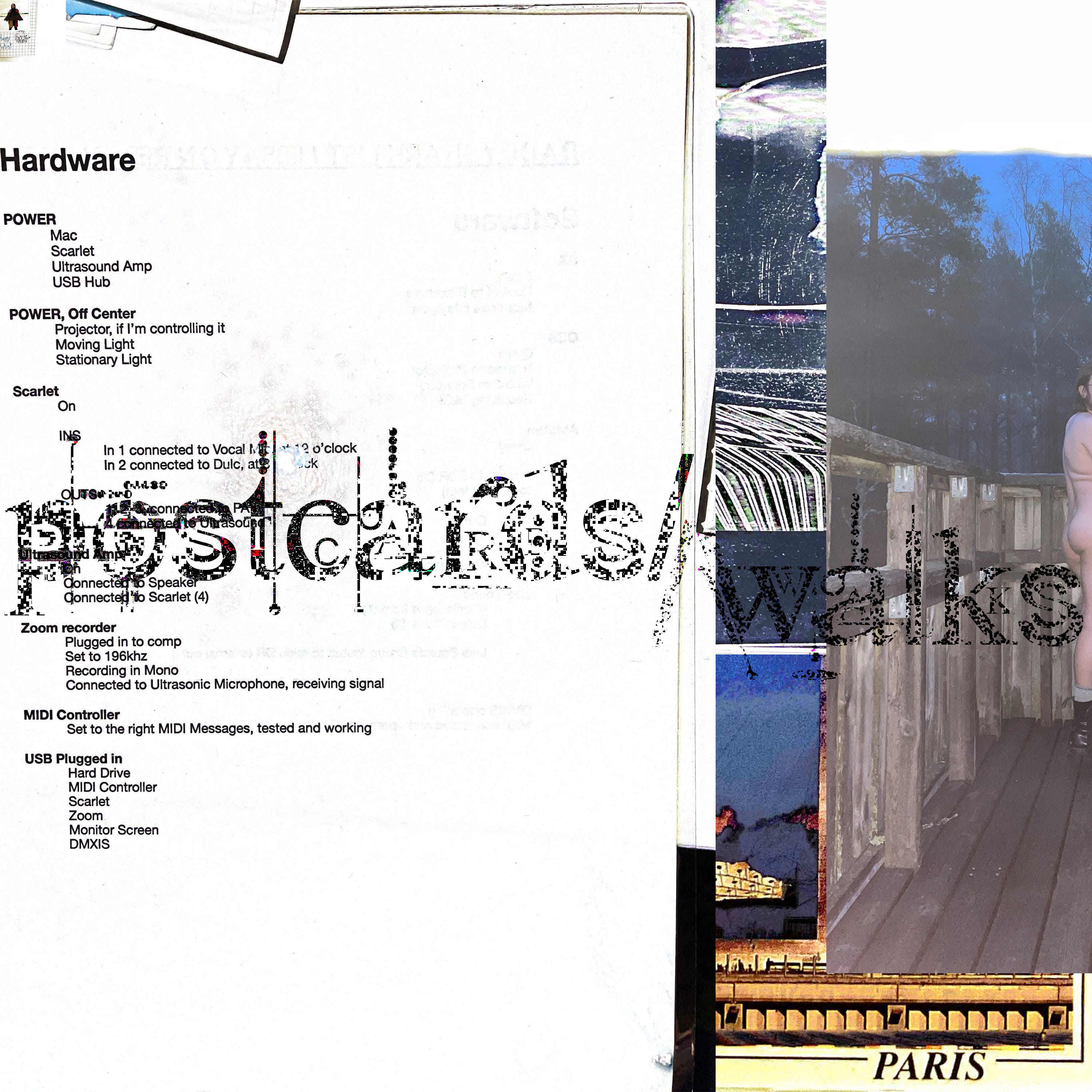
I’m releasing a little compilation called POSTCARDS/WALKS on Bandcamp to raise a little bit of money for that fund.
This is a collection of music that I made while at the Saari Residence in Finland. It’s a low-key thing, nothing too polished, and composed of music that I made as letters to friends (postcards) and music that I made alongside the Finnish countryside (walks). Maybe that’s an interesting thing! I think some of it is pretty good! Pay-what-you-can! Truly, no pressure here, though, I’m just happy to still be around.
****PROMO********PROMO********PROMO********PROMO********PROMO****
For years now, I’ve been a faraway admirer of Lydia Cheshewalla’s work. To my knowledge, we’ve never met, but we attended the same artist residency a few years apart from each other. (The Tallgrass Artist Residency in Kansas, an extremely dreamy dreamy place, maybe the most beautiful place I’ve ever been, in its Overwhelming Starkness and Realness.) Hers was the only residency artist talk I tuned into via digital stream. She lives in Chicago now, what luck!
Lydia’s recent work (which to fess up, I’ve really only experienced through instagram dot com and once IRL at the Center for Native Futures) consists of these ephemeral installations built from things she gathered nearby—little dried seeds and plants and stones—arranged in these elegant geometric compositions, with a sense of visual clarity and balance and motion that makes me so so so envious. (Idk if we’ve talked about this before, but I’m not, like, a visual person. And yet my job is to teach art! I’m a con artist, a fraud!)
Part of the conceptual thrust of the work is the process of gathering, of attunement with place. In conversations about this, Lydia frames her materials as not only collaborators, but as kin, stressing that the collaboration between artist and material is a genuine relational collaboration, emerging from a long relationship between the two parties. It’s an exciting&important frame in that it gives the seeds and rocks and flowers agency, lending these things a personhood so denied by our humanist culture.
Another part of the work, the part I want to linger with, is its ephemerality. The work goes away—both because of natural decomposition and because her very own human hand returns the pieces to the land at the conclusion of the work.
Here’s the shortest manifesto of all time, taken from Lydia’s website…
Ephemerality rejects immortality, preciousness, and art pollution.
Ephemerality denies the value systems of the institution, the white cube, and scarcity.
Ephemerality finds value in abundance, rejecting anthropocentric views that deem humans the only artistic creators.
Ephemerality is a meditation on the constant cycles of death and renewal present all around us.
This word, ephemeral, is clearly close to Lydia’s heart, her bio reads, “Lydia Cheshewalla is an Osage ephemeral artist from Oklahoma.”
Ephemeral artist!
Did you know you could simply claim the world you want to be in?!
I did, indeed, still perform in Paris at this wonderful bar called Chair de Poule (“the Cafe Mustache of Paris” per Anna Johnson). The show ended up being really lovely, a kind of acoustic-extended-improvisation on the gestures of the piece I had planned to perform. It was much more meandery and had accompaniment from a small army of little soundmakers I collected while traveling. Most of the piece was there, except for any of the songs. (Without the beat, the songs aren’t anything!) The exception was The Riddle Song, which I did play, because it is a special song with special powers.
I’m grateful for the Paris show, for, if nothing else, reminding me that the piece was most in my body and the body of my instrument. Both of these are the genuine irreplaceable elements.
But I don’t want to linger here at my body, because my body is still here. I want to point back at the objects, still somewhere on vacation in France.
This past June, Matthew Goulish and Lin Hixson were invited as guests for a panel called Beyond the Binary | Beyond Composition and Collapse hosted by the Design Studio for Social Intervention, a design(?) studio(?) in Boston that seems cool as hell.
I really don’t know anything about this outside of the extremely glitchy YouTube video I’ve watched through a few times. Even with the fritzy audio, it’s a compelling window into how these two artists, people I consider very important mentors and models, are thinking about this political moment.
In prepared remarks, M.G. quotes The Bells of Nagasaki by Takashi Nagai, describing a scene in which a narrator, trapped under the debris of a collapsed classroom, realizes the blast has loosened the floorboards. Instead of the more obvious route—escape from above—the way out is from below. A demonstration of “when you cannot solve a problem, think of the contrary.”
In the Q&A somebody asks the big question. More or less: “In the face of ascendant fascism, how do we find the floorboards?”
Here is my transcription of Matthew’s answer:
I wouldn’t venture to fill in actuals, in terms of the analogical interval, what the “floorboards” might be in our situation. I’ll leave that to people who devote their lives to social engagement in a way that I, as a teacher and a writer, don’t have experience [with].
But every obstacle is an opportunity and [unintelligible]. It’s maybe not the opportunity you hoped for or were expecting, but if you can accept the opportunity that it actually is, then that kind of attention, in the moment, can answer the question.
Rather than planning for it, the right kind of attention prepares you to recognize the opportunity.
There are two things I really like about this answer. The first being the punt. This feels like something we should all get better at practicing. There are exceptions, of course, but the simple truth is that artists are generally not the people you want to lead the revolution! Painful to admit, but perhaps useful to internalize!
The second thing I like about this answer is the obstacle provocation. It’s not unusual to suggest that “when one door closes another opens,” but I think M.G. is honing in on something more subtle. The actions that turn obstacle to opportunity are attention and recognition.
Lydia’s practice is, to absolutely squash it for sake of comparison, a practice of collection followed by design4, informed by a light touch and a collaborative orientation towards the world / the land / the universe.
In a similar way, we might see my practice as one of collecting performative things and designing them in a particular order. This, too, blows away into dust at the conclusion of the show (via the curtain closing, as well as via Parisian larceny).
Lydia’s work goes away. So too, my work. What’s different here?
One difference is that my performances lean on technology to make the thing a spectacle—lights and computers and microphones, etc. This infrastructure is what is still in Paris. It’s also, importantly, only scaffolding, as I learned by performing the acoustic iteration.
But I’m not satisfied with just that. It feels like I lost something of the piece itself, not just the thing supporting it. Is that an emotional reaction, my poor ego clinging to the material world? Or is this a real change in the meaning of the work?
This is the question I want to poke at a bit further: what is it, precisely, that the piece lost when my shit got swiped?
Let us first figure out what “the performance” is.
My go-to definition has always been that a work of performance exists not:
a) in the work itself, or
b) in the audience’s mind
but rather:
c) in the relationship between these things.
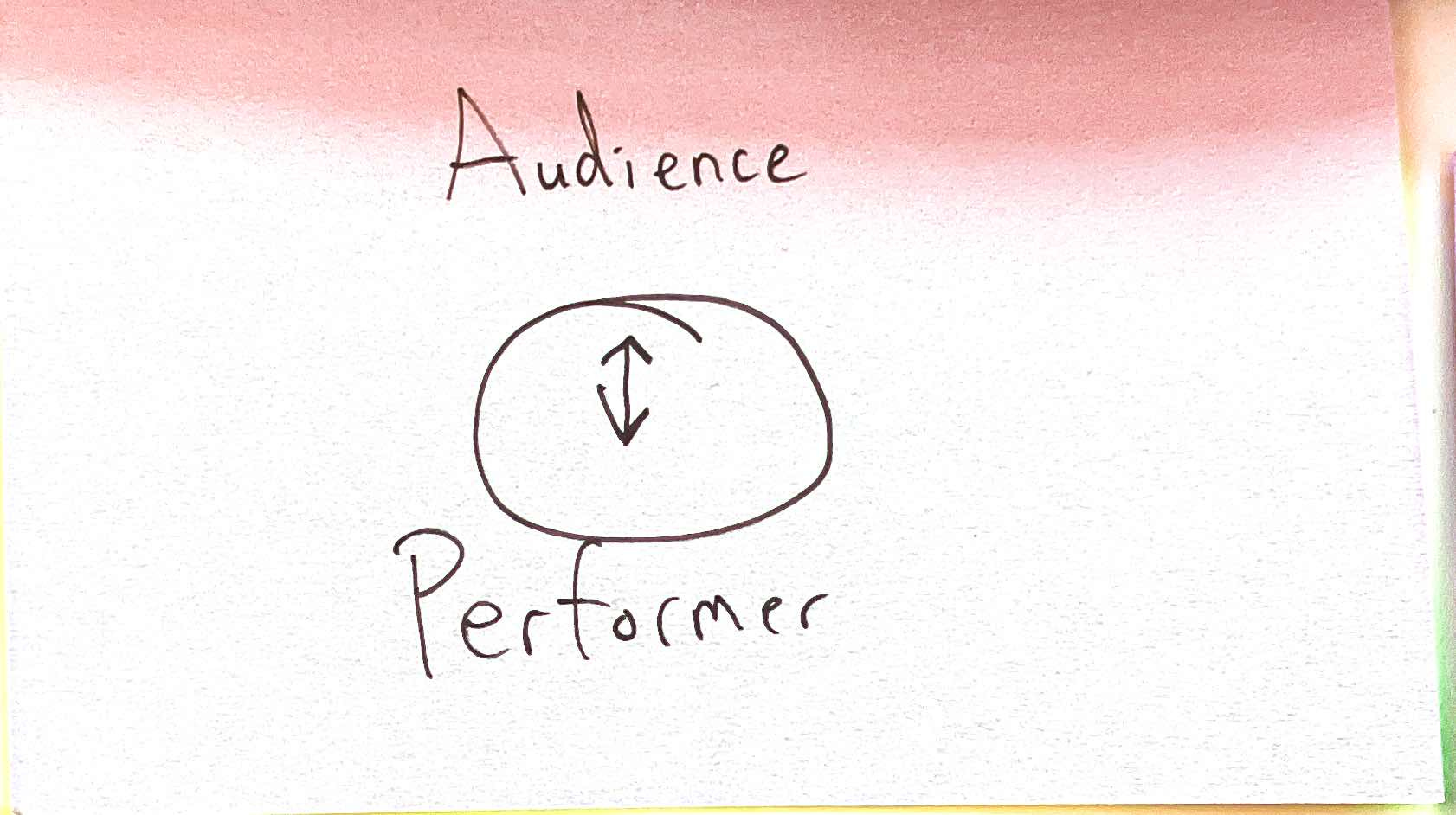
But I always struggle with this because it’s hard to talk about “a relationship” as if it’s a thing out there in the world. A relationship is an idea over time and is, troublesome bugger, invisible. We are aided here by a diagram. I’ve circled where the meaning might be:
Except in Essay on Resonance, at least, there is this additional layer of infrastructure that also feedsback with the performer. Let me propose to you a new diagram:
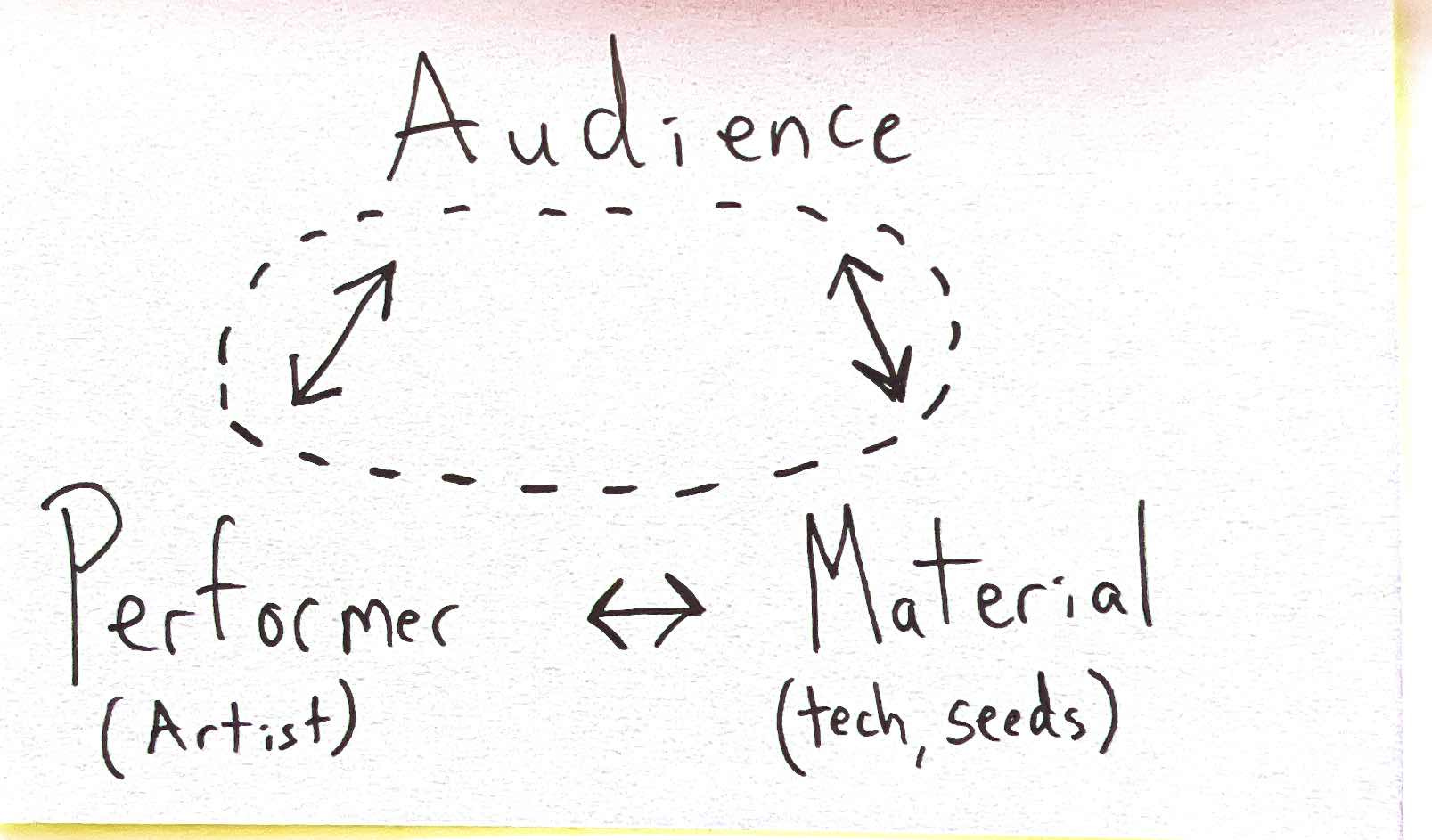
“The performance” here exists in superposition5—both between Audience-and-Performer AND Audience-and-Material, until the audience’s attention collapses it down to just one arrow. I know that sounds ridiculous, but bear with me here.
My experience of watching a performance—the mind wanders! I’m a weak, distracted, fragile witness. My attention is diffuse, I linger with a particular sound or image for a while and then I go back to the full composition and then I think about the things I have to do for the next day and then I notice my legs have fallen asleep and I keep circling until there is a sufficiently loud sound to wake me up, be it the crash of the sound designer or the thunder of applause.
This is the encounter that is supposed to “mean” something, and it’s weird and hard to reduce it to one arrow in the abstract. And you only really reduce it when your attention picks a direction.
Another way of saying this is that “the piece” is distributed. You can’t point to one part and say “that’s the work.” Instead, it’s sorta everything all tangled together in that particular moment. Always changing and also pretty messy.
When my stuff went missing, so too did a whole field of meaning that the work could hold. I suspect that by losing technology specifically, the flavors that I lost were about spectacle—about how the lights and sounds feel larger than life, feel larger than human, capture and direct attention in very forceful ways.6
The performance in Paris lacked spectacle, and so it moved closer to my body, the small sounds I can control and sculpt, the gaze of the crowd, all tied up in a tangly knot. (That again, only reduces when you choose a way to look.)
I come back to the phrase “Ephemeral Artist.” Should we all dare ourselves to that level of responsibility.
By some good fortune, I happened to be in Paris at the same time as Michael Pisaro and Antoine Beuger, two pillars of the Wandelweiser Group, a collective of composers and performers who have carried a mantle of Cagean silence and Oliverosian deep listening, that thread of “experimental” music that is maybe the most exciting to me.7
At the concert, they performed A.B.’s Now is the Moment to Learn Hope. Here’s the score, nothing more:
play one sound / caringly / daringly / over and over / again and again / in wondering pondering communion / trustingly / not knowing how and when to end
The piece is really stunning in that, after the first 30 seconds, you know exactly what is going to happen. And also! You have no idea what the order will be, or how it will end, or how the musician picked these sounds in the first place. You wonder if these are enough questions to chew on for a 47 minute single-track album.
Turns out: yes, the result is a pretty lovely musical experience. I mean, I had the experience I almost always have with live music, which is in and out, lingering, losing, predicament, legs, wow8, trombone, hope.
I found it quite provocative to think with the title, especially given the spartan nature of the music/performance itself. The title itself comes from a John Holloway talk very much oriented toward politics, not at all about art. Here’s the passage:
“Now is the moment to learn hope. Now, when there seems so little ground for hope; Now, when refugees and migrants are drowning in the sea; Now, when racism and fascism are surging in Europe and North America and elsewhere; Now, when even to mention hope seems like a sick joke or an insult to millions and millions of young people who face a life of unemployment, or sometimes worse: employment. Now is the time to learn hope . . . not just to hope that everything will be alright. But to learn hope . . . hope as a way of thinking that opens paths to a different world.”
Unexpected to hold that thought next to this very very abstract music.9 While listening I find myself asking: what do I hope for? What do I need to learn? Watching the trombone player breathe in and start to play again, I might hope for the sound to be something different, but I know better. His mouth has been trained to repeat these same shapes, the sound will always be delightfully confusable with the previous one.10
I mean, to cut to the obvious, I hoped that someone had accidentally taken my bag and saw my medication and my name and was planning to take it to the bus depot in the morning.11
Where do I learn that, that extremely small prayer in a sea of horrors? In other words, is “Now is the Moment to Learn Hope” an act of collective meditation? I scrawl on a napkin:
Meditation12 = recognition of what is
Hope = an orientation toward what could be
Oh dear, I think we’re swimming to ephemerality=death
Duh, Corey! Color=death, Music=death, Performance=death, Everything=death!
And still, how my infrastructure might enable death! How that infrastructure, too, might be chased by oblivion even while it creates oblivion.
The artwork changes something small in the world, but all of these changes keep changing so I can’t track cause and effect anymore. Even when you know the trombone will play the same note, it always sounds different. I hope I hope I learn hope.
Okay, thanks for sticking with me and processing. Maybe now that everyone has tabbed away is a good time to write…
I’ll be performing ESSAY ON RESONANCE (in some shape or form) at Elastic Arts! On May 13th at 8pm! Heavy Tiny (Lia Kohl and Nick Merryhew) open.
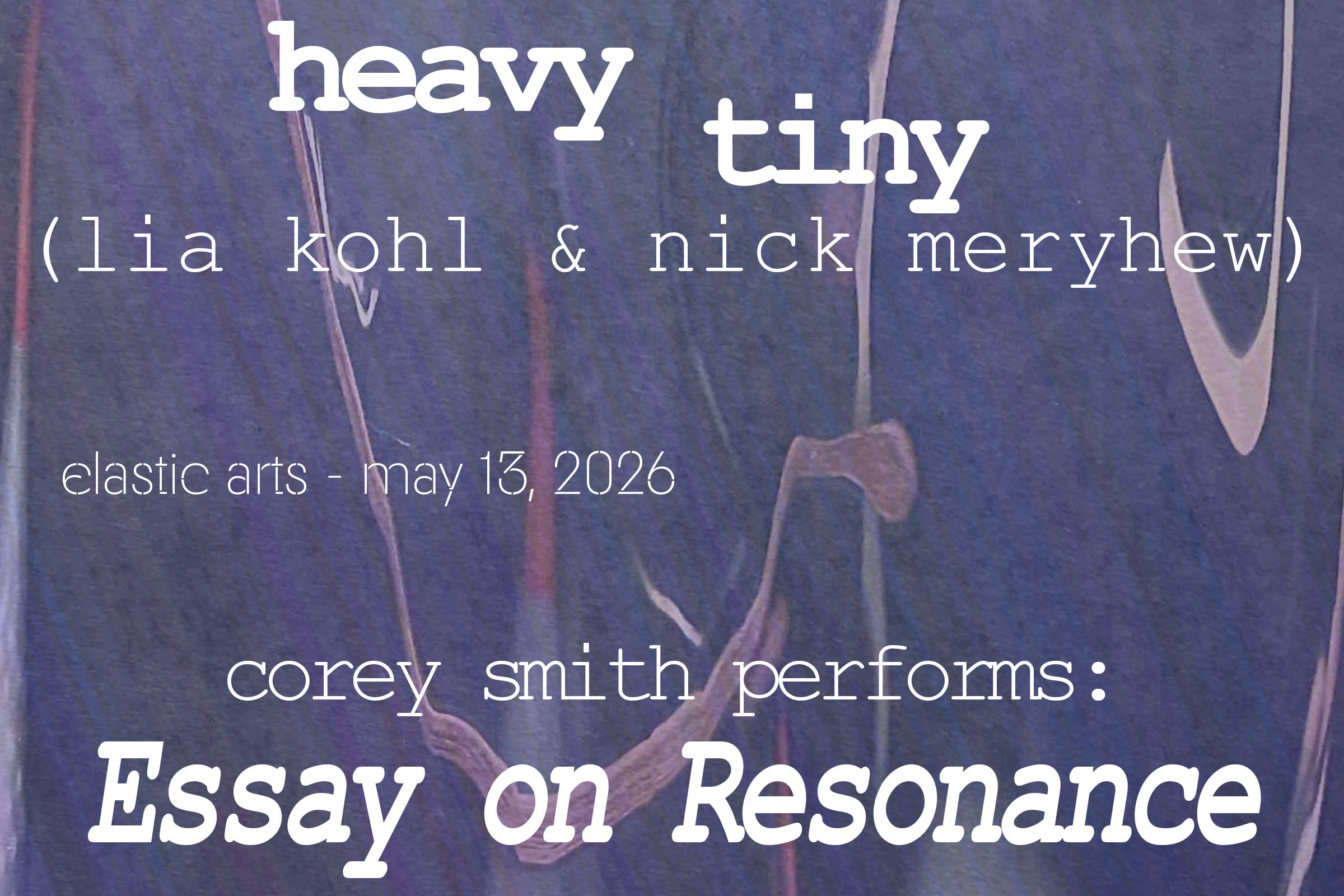
Save the date! C U THERE
love u,
c
Not quite understanding how to do it the proper American way, an ignorance evidenced by ample bike lanes.
Including a Finnish rock that makes it to Paris, but they finally took it from me at CDG!! Security said I couldn’t have my rock :(
Thankfully, most of the digital files were all backed up on ~the cloud~. The exception to this is some very fancy documentation from the Inter Arts Center in Malmö, which I didn’t back up because the files were each like 100GB or something. This is the part that smarts, I’ll be real.
Part of what excites me about Lydia’s work is how slippery it is. Calling Lydia’s compositions “very very slow performance” is one part exciting and one part reductive. Same with framing the work as paintings or sculptures or installations or or or….The boxes that we have don’t fit! It is composed of a bunch of different things and it’s just weird to distill it. In part, I think, because she sitting with entropy for as long as possible. Different plum.
Okay the flaw in this metaphor is that a quantum function collapsing means that it settles into one state and is no longer in superposition. I’m trying to describe something that, instead, oscillates at the speed of an audience member’s phone-fried attention span. However: “superposition” does get at the limbo vertigo feeling, and that’s my emotional truth. Sorry 2 the physicists out there 4 nothing!!
I feel very connected to the idea of lineage here—the tradition of performers going back to pre-history, who got really really good at storytelling, as the earliest incarnation of this technology. I have weird and complicated feelings about “storytelling,” don’t get me started. But just know I think it’s a Very Very Imporant Human Practice.
I’ve been out of the contemporary music circuit for some time, so take this all with a HUGE grain of salt. As far as I can tell, the really gnarly experimental music in 2026 has a few threads it could follow—these might be:
more noise more control more difficult
more hybridity more blurring more rupture
more soft more in mind more organic.
My allegiance is vaguely with the soft/mind/organic school, maybe because it’s easier on the ears or maybe because I teach this stuff with some frequency. The Wandelweiser cats sit very squarely here, also.
What was very special was witnessing the specific virtuosity of Pisaro performing, which involved some of the most restraint I’ve ever felt from a musician on stage. He made a small short sound on a pitch pipe maybe four times across the 20 minutes of the performance
Contrast this to the students playing with him in the ensemble, who were simply put, noodling their contact microphones. Virtuosity takes so many shapes.
Not unapproachably difficult music! But also not precisely playing by the same rulebook that, for instance, protest music does (whether folk or popular).
The rich “tuh” of a low brass articulation! Unironically very moving. Listen to some euphonium, dudes.
Okay, I also hoped for the important things. Of course I did. I hoped for the wars to be over. Better yet, I hoped we win the wars. (Not the state! Us! The sensibly oriented radicals, ready to try to scale everything down, to proceed with a love for each other and for the future.)
I mean, really, I hoped for the president to croak.
Thich Nhat Hanh uses the words “deep listening” even!